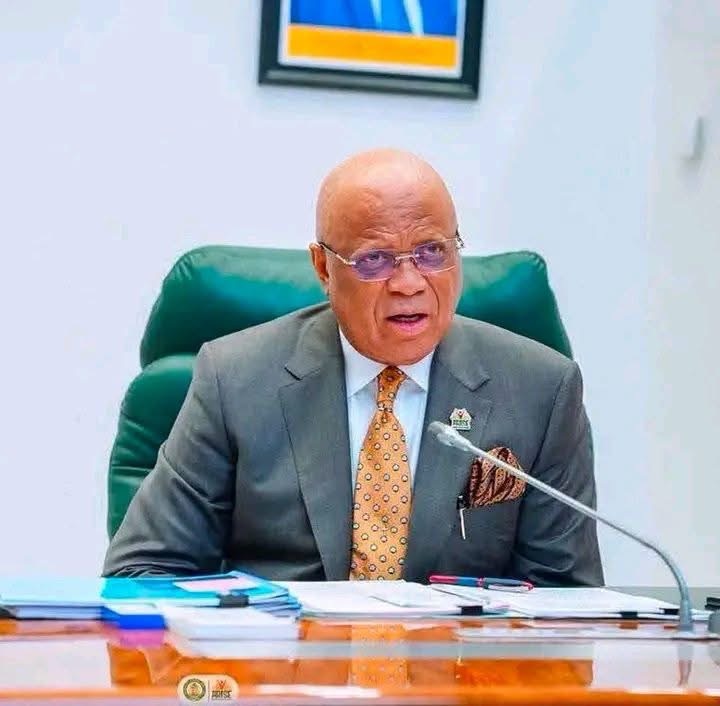
Eno Government Moves to Tackle Dead Trees, Flooding and Waste
Priscilla Christopher-Akpanettot
The Akwa Ibom State Government is set to commence the removal of dead and potentially hazardous trees in Uyo, as part of measures to improve public safety and strengthen environmental management across the State.
The Commissioner for Environment, Hon. Nsikak Ekong, disclosed this in Uyo on Thursday, September 24, 2026, while briefing members of the press on the milestones recorded by his ministry under the administration of Governor Umo Eno since the beginning of his tenure in 2023.
Ekong said the Ministry was currently taking stock of trees planted across the state capital, after which trees requiring pruning or complete removal would be attended to.
The Commissioner’s announcement comes weeks after a tree-fall incident along Abak Road in Uyo resulted in the death of a commercial motorcyclist, underscoring the need for closer monitoring of trees within the metropolis.
He appealed to residents to exercise patience with the Ministry’s team as the exercise gets underway, stressing that the intervention was part of a broader effort to ensure environmental safety.
Ekong also announced plans for fresh tree-planting activities in Ikot Ekpene, indicating that the government’s environmental strategy would combine the removal of hazardous trees with the planting and nurturing of new ones.
He said the objective was to maintain a healthier and safer urban environment while sustaining the state’s green initiatives.
On flooding, the Commissioner said the government had undertaken drainage desilting around Abak Road, Aka Road and Ikot Ekpene Road, as well as in Shelter Extension and other areas affected by flooding in Uyo. He explained that while some of the interventions were temporary measures, the government was working towards more permanent solutions through the review and updating of the Uyo Urban Drainage Master Plan.
According to him, the updated plan is expected to reflect the realities of rapid urbanisation, climate-induced flooding and changing water-flow patterns arising from increased construction and paved surfaces.
The government has also approved the Clean Akwa Ibom Brigade, an environmental enforcement team expected to monitor flood-prone areas and strengthen compliance with environmental regulations.
Ekong said erosion-control interventions were ongoing at the Ravine along the Uyo-Ikot Ekpene Road and at Ikot Ekpene Market, while reclamation work continued at the former Village site dump area, which has been earmarked for redevelopment.
On waste management, he disclosed that Akwa Ibom generates approximately 700,000 metric tonnes of solid waste annually, representing about 2,000 tonnes daily. He said the government was engaging consultants on waste-to-energy initiatives and other methods of converting waste into useful products, including recycling plastics and processing organic waste into fertiliser.
Earlier, the Commissioner for Agriculture and Rural Development, Dr Offiong Offor, outlined the administration’s interventions in the agricultural sector, including subsidised mechanisation, farmer grants, rural roads, improved seedlings and the expansion of tree-crop production.
Offor said the State had established an equipment-leasing arrangement through which farmers could access tractors and other agricultural implements at a 50% subsidy on land preparation.
The initiative, she explained, was designed to reduce reliance on traditional farming methods and make mechanised agriculture more accessible to farmers.
The administration has also provided ₦2 billion in grants to farmers across crop and livestock value chains, with monitoring teams deployed to follow up on beneficiaries and ensure that the funds are applied to their intended purposes.
The Commissioner said the Rural Access and Agricultural Marketing Project (RAAMP) had earmarked 486 kilometres of rural feeder roads across the state’s 31 local government areas. The project, jointly funded by the World Bank, the French Development Agency, the Federal Government and the state government, is expected to improve farmers’ access to markets while reducing post-harvest losses and facilitating access to schools and healthcare facilities in rural communities.
Farmers have also benefited from the distribution of agricultural inputs, including cassava cuttings, maize and pumpkin seeds, while support has been extended to cocoa growers. Under the Tree Crop Revolution Programme, more than 250,000 oil palm seedlings are targeted for distribution across the 31 local government areas. Fourteen local governments have so far received seedlings, with about 1,700 farmers reached.
The State also distributed more than 250,000 cocoa seedlings to over 3,000 farmers in 2025, while more than 100,000 seedlings were distributed to over 850 cocoa farmers in 2026.
Offor further disclosed that a 50-hectare integrated model farm had been developed to combine crop and livestock production with training, processing and agro-tourism facilities. The facility includes fish ponds, piggery and poultry components, greenhouses, processing facilities and accommodation.
Young people trained through the facility are being encouraged to establish smaller versions of the integrated farm under the Back-to-Farm Initiative, while the Schools Agriculture Programme and Young Farmers Club have also been reactivated. The Akwa Ibom Agricultural Development Programme (AKADEP) has equally been revamped to strengthen agricultural extension services.