


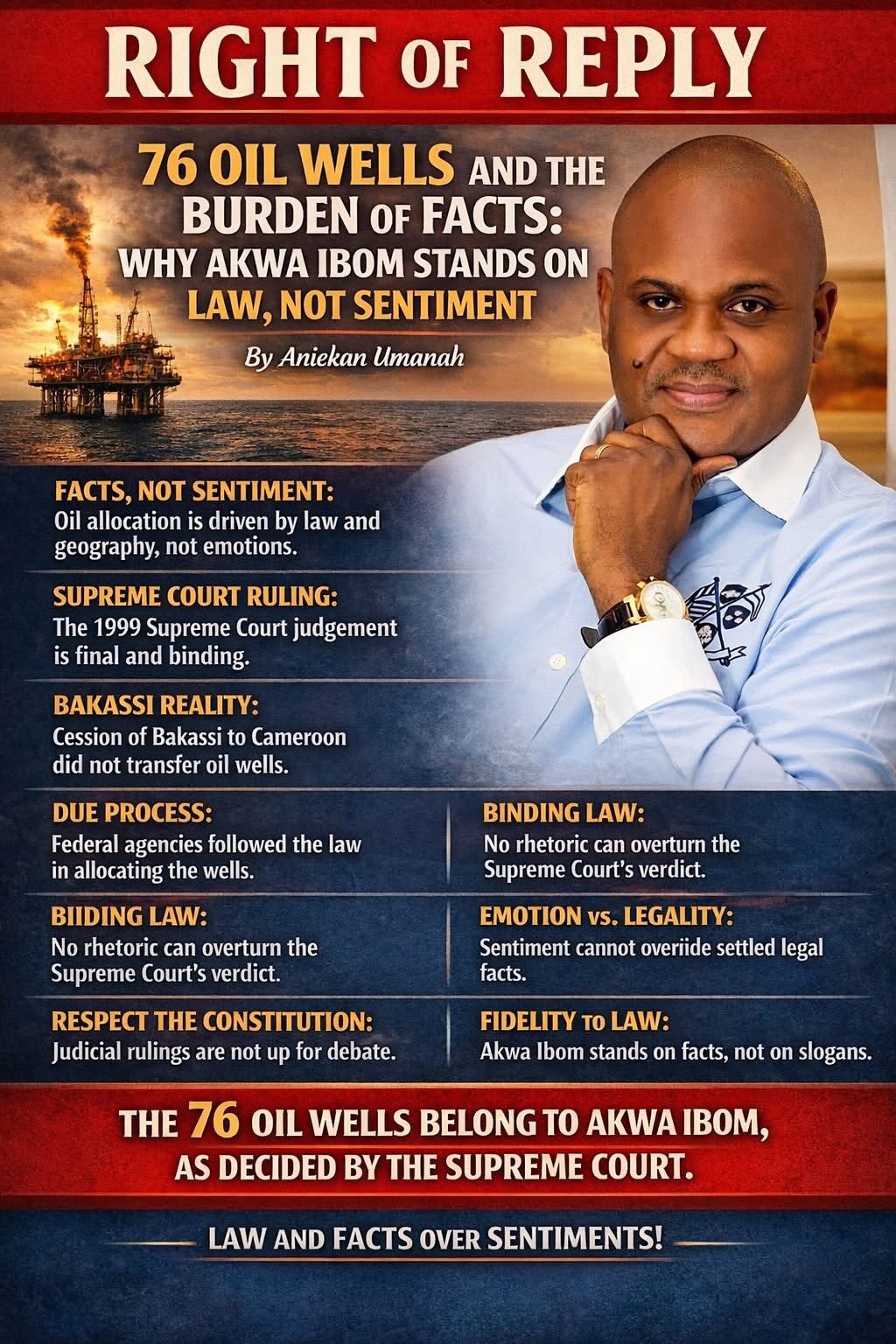

RIGHT OF REPLY: 76 OIL WELLS AND THE BURDEN OF FACTS. WHY AKWA IBOM STANDS ON LAW, NOT SENTIMENT
By Aniekan Umanah
Recent calls by the Cross River Patriotic Front for the so called return of 76 oil wells allegedly taken from Cross River State are misplaced. They reflect a deep confusion between sentiment and law, and a disregard for settled facts.
The controversy being promoted is not new. It was examined exhaustively, reviewed thoroughly, and conclusively resolved by Nigeria’s highest court. Relevant federal institutions acted on that judgment. The matter is closed in law. What persists today is not a dispute of facts, but a refusal to accept them.
First, the 76 oil wells belong to Akwa Ibom State.
Based on established maritime boundaries and internationally recognised hydrographic coordinates, the wells lie within Akwa Ibom’s littoral territory. Their location is not a matter of opinion. It is a matter of geography supported by law.
Cross River State is non littoral. The wells do not fall within its maritime space. No legal principle allows assets outside a state’s territorial and maritime boundaries to be claimed by assertion.
Second, oil well attribution follows law and location.
Under Nigerian constitutional practice and international maritime jurisprudence, oil wells are allocated by legally enforceable boundary determinations. Rallies, press statements, or emotional appeals have no standing in this process.
Third, the Supreme Court judgment is final and binding.
Section 235 of the 1999 Constitution makes the judgment of the Supreme Court final. It cannot be reviewed by committees, advocacy groups, or political rhetoric. The court held clearly that Cross River State lost its littoral status following the cession of the Bakassi Peninsula and therefore ceased to qualify for offshore derivation claims. That position remains the law.
Fourth, the Bakassi cession did not transfer offshore oil wells to Cross River State.
The 2002 judgment of the International Court of Justice and the subsequent treaty transferred sovereignty over Bakassi to Cameroon. It did not and could not transfer offshore oil assets located outside the ceded territory to Cross River State. Legal loss, however painful, does not create new entitlements elsewhere.
Fifth, due process was followed in attributing the wells to Akwa Ibom.
Federal technical bodies, including the Revenue Mobilisation Allocation and Fiscal Commission, the National Boundary Commission, and the Office of the Surveyor General of the Federation, relied on technical and empirical data to determine entitlement. These institutions act on fixed geographic coordinates. Assertions cannot alter static facts.
Sixth, the Supreme Court judgment is law, not advice.
No inter agency process, no committee, and no pressure group can sit in appeal over the Supreme Court. This is not a political argument. It is constitutional reality.
Seventh, emotion cannot displace settled legal reality.
The loss of Bakassi was a profound national experience. It deserves empathy and historical reflection. It does not, however, generate legal rights where none exist. Sympathy does not confer jurisdiction. Law does.
Eighth, the current agitation undermines constitutional order.
Calls to divert lawfully allocated derivation revenue or to redraw maritime boundaries without judicial authority threaten fiscal stability and national cohesion. They weaken respect for the rule of law.
Akwa Ibom State has consistently pursued peaceful engagement and respect for judicial finality. It remains committed to cooperation and unity. At the same time, it will defend what is rightfully hers through law and documented fact, not slogans or sentiment.
For clarity, the 76 oil wells, and any others within the same maritime corridor, are not assets awaiting return. They are firmly vested in Akwa Ibom State by the Supreme Court of Nigeria.
No petition, committee, or press statement, regardless of tone or volume, can alter that legal reality.
Thank you.