



Political Leadership or Political Dominance; A Forensic Examination of Equity, Representation, and Power in Oro Nation
Three Decades After: Udung Uko Yet to Produce Reps Member, Equity Debate Emerges in Oro Nation
For over three decades, Oro people have invested trust, votes, legitimacy, and goodwill in one individual; Senator Akon Eyakenyi.
Political memory is not ornamental; it is evidentiary. And in democratic systems, particularly within Nigeria’s intensely competitive and often predatory political environment, evidence matters.
The Book of Judges records that when Israel drifted, Deborah rose not merely as a symbolic woman in authority but as a jurist anchored in established moral order. Her leadership was corrective, not acquisitive. She judged according to “ancient landmarks.”
Oro Nation must now interrogate whether its own landmarks are being preserved, or quietly dismantled.
Her rise is not disputed. From auxiliary primary school teacher to local government supervisor, state board member, state executive council member, state board chairman, federal minister, again state board chairman, senator representing Akwa Ibom South, and now Deputy Governor of Akwa Ibom State, her political résumé is extensive and verifiable.
But longevity in office is not synonymous with justice in office.
Oro did not stumble into elevating her. The deputy governorship was neither wrestled nor begrudgingly conceded; it was conferred with communal endorsement. This is significant in a political culture where female leadership at that level remains relatively rare. Oro demonstrated progressiveness.
However, progressiveness loses credibility when equity collapses.
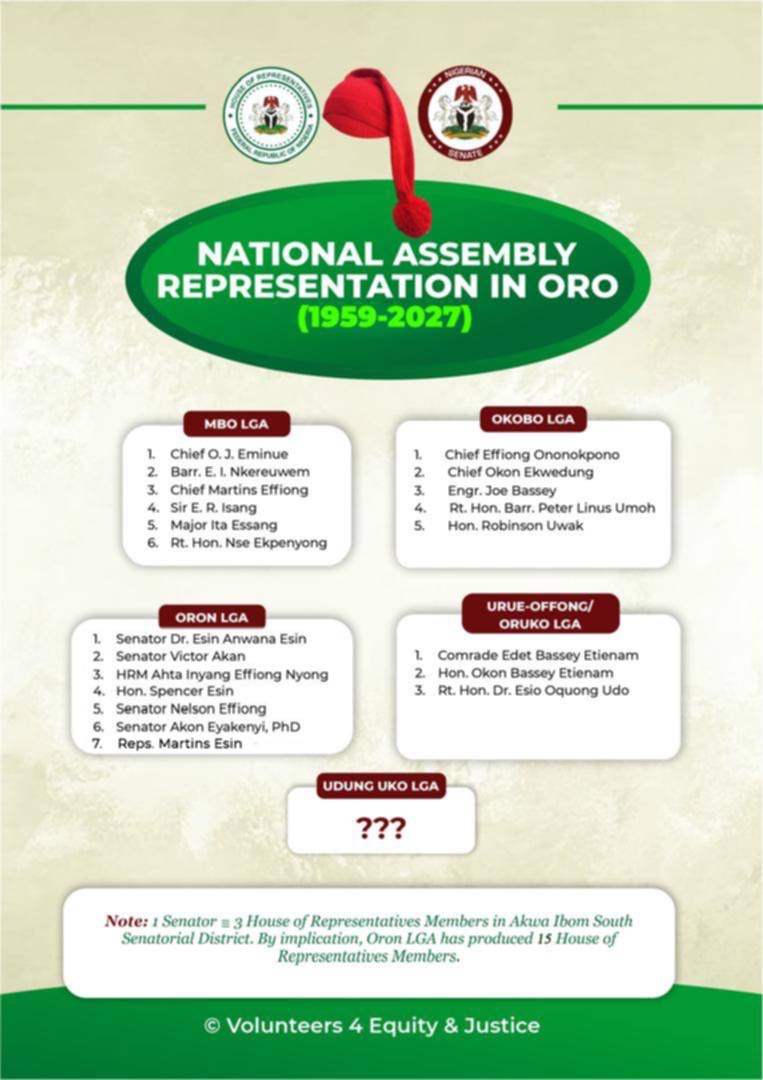
Since the inception of Nigeria’s Fourth Republic in 1999, Oro Nation has operated an informal but observable rotational logic concerning the House of Representatives seat for Oron Federal Constituency. The five LGAs; Mbo, Okobo, Oron, Urue-Offong/Oruko, and Udung Uko, form the constituency.
Historical representation records are clear:
Mbo LGA – Six representatives:
Chief O. J. Eminue
Barr. E. I. Nkereuwem
Chief Martins Effiong
Sir E. R. Isang
Major Ita Essang
Hon. Nse Ekpenyong
Okobo LGA – Five representatives:
Chief Effiong Ononokpono
Chief Okon Ekwedung
Engr. Joe Bassey
Rt. Hon. Barr. Peter Linus Umoh
Hon. Robinson Uwak
Oron LGA – Seven representatives:
Senator Dr. Esin Anwana Esin
Senator Victor Akan
HRM Ahta Inyang Effiong Nyong
Hon. Spencer Esin
Senator Nelson Effiong
Senator Akon Eyakenyi
Rep Martins Esin
Urue-Offong/Oruko LGA – Three representatives:
Comrade Edet Bassey Etienam
Hon. Okon Bassey Etienam
Rt. Hon. Dr. Esio Owuong Udo
Udung Uko LGA
Zero representatives.
Not one.
This is not rhetorical exaggeration. It is statistical reality.
Udung Uko LGA remains the only Oro Nation local government area yet to produce a National Assembly representative since 1959.
Meanwhile, Oron LGA, the Deputy Governor’s home base, has produced seven federal representatives and, between 2015 and 2023, dominated the Oron/Udung Uko State Constituency across key political positions, including:
The State House of Assembly seat,
National Assembly representation,
Commissioner portfolios,
Board memberships, and
Other executive appointments
The pattern is visible. It is measurable. It is defensible only if equity is no longer the guiding principle.
When one LGA consistently dominates federal, state legislative, and executive representation within a rotational framework that historically emphasized balance, political analysts no longer call it coincidence. They call it consolidation.
While serving as Senator for Akwa Ibom South, and leveraging her influence as a former Federal Minister, Senator Akon Eyakenyi secured the Deputy Governorship position, with the backing and endorsement of the Oro people.
That, in itself, is not unlawful.
However, the fact is that she is widely believed to have supported the emergence of Rep. Martins Esin for the House of Representatives seat in 2023, effectively short-circuiting Udung Uko’s opportunity, speaks to a troubling concentration of political leverage.
In systems where internal party democracy is weak, influence functions as power. And power without restraint produces exclusion.
As 2027 approaches, rather than initiating corrective balancing, reports indicate active discouragement of Udung Uko aspirants. The alleged cautioning of Engr. Bobby Onofiok against contesting the House of Representatives seat illustrates a climate of political intimidation rather than inclusion.
If accurate, this signals not leadership but gatekeeping.
At 64, an age often associated globally with statesmanship and legacy consolidation, the optics of continued positional accumulation raise legitimate questions about distributive justice within Oro’s political ecosystem.
Leadership matures when it transitions from acquisition to arbitration.
Oro’s identity is deeply tied to fairness. The federal seat has historically rotated because the people understood a simple truth; representation must circulate to preserve unity.
If Oron LGA seeks to retain the House of Representatives seat again in 2027, then equity logically requires relinquishing another major political position, most reasonably, the deputy governorship, to Udung Uko.
This is not hostility. It is equilibrium.
If both positions remain concentrated within one LGA, the moral argument for rotational justice collapses entirely.
The responsibility now transcends local maneuvering.
The leadership of the All Progressives Congress (APC) in Akwa Ibom State, particularly:
His Excellency Pastor Umo Eno, PhD
His Excellency Dr. Godswill Akpabio, GCON
must ensure that party structures do not become instruments of structural exclusion.
Oro unity is not sustained by dominance. It is sustained by fairness perceived and fairness practiced.
Udung Uko’s political suffocation is neither invisible nor imaginary. It is documented in representation data spanning beyond twenty-five years of Nigeria’s Fourth Republic.
Nigeria’s democracy is often described as transactional and predatory, where incumbency advantages, patronage networks, and influence hierarchies frequently override internal equity.
Oro Nation must decide whether it will replicate that pattern internally or resist it.
The test of leadership is not how firmly one holds power, but how responsibly one redistributes opportunity.
Martin Luther King Jr. warned that injustice anywhere threatens justice everywhere. In microcosm, Udung Uko represents that warning.
If Oro cannot guarantee fair representation among five LGAs, it weakens its moral claim in broader state and national negotiations.
This is not a gender issue.
It is not an age issue.
It is not an anti-progress argument.
It is a governance issue.
When one LGA accumulates:
Deputy Governorship
Dominant federal representation
Legislative seats
Executive appointments
while another remains perpetually excluded from the National Assembly, the question is no longer political strategy, it is distributive justice.
Power can be used to correct imbalance.
Or to entrench it.
History will record which path was chosen.
Powered by Volunteers 4 Equity & Justice